

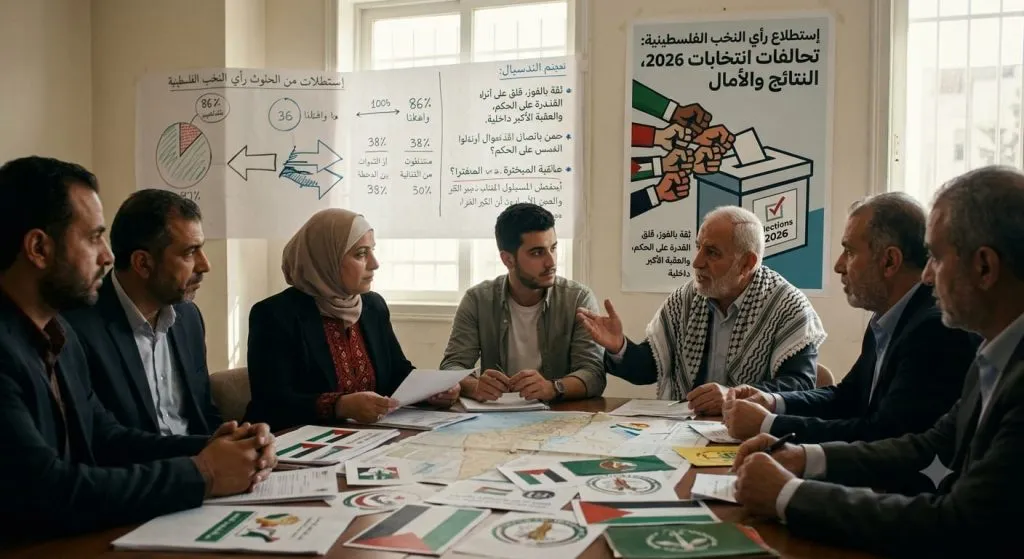
Ufuq Center for Studies and Research has released the results of an opinion poll titled "The Future and Prospects of the Broad Factional Alliance in the 2026 Legislative Elections." The poll gauges the attitudes of Palestinian elites toward the announcement by Palestinian factions of an electoral alliance to contest the legislative elections scheduled for 28 November.
The poll was conducted online between 8 and 13 September 2026. It surveyed 26 respondents, among them researchers, politicians, academics and civil society activists from the West Bank, Gaza and the diaspora: 16 from the West Bank, including Jerusalem, 7 from the Gaza Strip, and 3 from the diaspora. Respondents fell into four categories: civil society activists (8), researchers and political analysts (7), political and party elites (6), and academics and media professionals (5).
The results show that 58% of respondents see a real opportunity for a broad alliance of Palestinian factions to take shape, compared with 19% who see no such opportunity and 19% who are undecided. Among those who did not rule out the formation of the alliance, 81% described its announcement as a positive and necessary step toward ending the division and unifying Palestinian ranks. Sixty percent expected it to succeed in bringing in as many factions as possible.
On electoral expectations, 86% anticipated that the alliance would win an absolute majority in the Legislative Council. This group was evenly split between those expecting a decisive victory of more than 60% of seats and those expecting a simple majority of between 51% and 59%.
Optimism receded, however, when respondents were asked about the period after a victory. Fifty-seven percent viewed the alliance as a genuine gateway to reforming the Palestine Liberation Organization and national institutions. By contrast, 29% warned that it could reproduce the traditional quota-based power-sharing arrangement. Respondents were also divided over the alliance's capacity to address field and political challenges should it win: 38% rated this capacity as high, 38% as moderate and constrained by regional and international pressures, and 24% as weak.
The poll revealed a clear gap between the West Bank and the Gaza Strip. All responses that saw no opportunity for the alliance to form came from the West Bank, as did all assessments that rated its capacity as weak. By contrast, 5 of the 7 respondents in the Gaza Strip considered the alliance highly capable of addressing the challenges.
On the question of obstacles, 11 of 15 responses attributed the alliance's potential failure to internal Palestinian factors. Chief among them were the resistance of power centers within the Palestinian Authority and the PLO to change or to the election results, and the absence of a common political program among the factions. Three responses pointed to the occupation and its potential recourse to arresting or targeting candidates.
The Center concluded that the surveyed elites see the alliance as a likely successful electoral vehicle, but do not regard victory alone as a guarantee of change. In their assessment, the greatest challenge lies in ensuring that election results are respected. It also lies in building a shared political program that prevents the alliance from becoming a new formula for quota-based power-sharing.
The Center noted that the poll sample is a purposive elite sample. Its findings should therefore be read as indicators of this segment's attitudes rather than as representative of Palestinian public opinion. The full results are available via the attached link.