

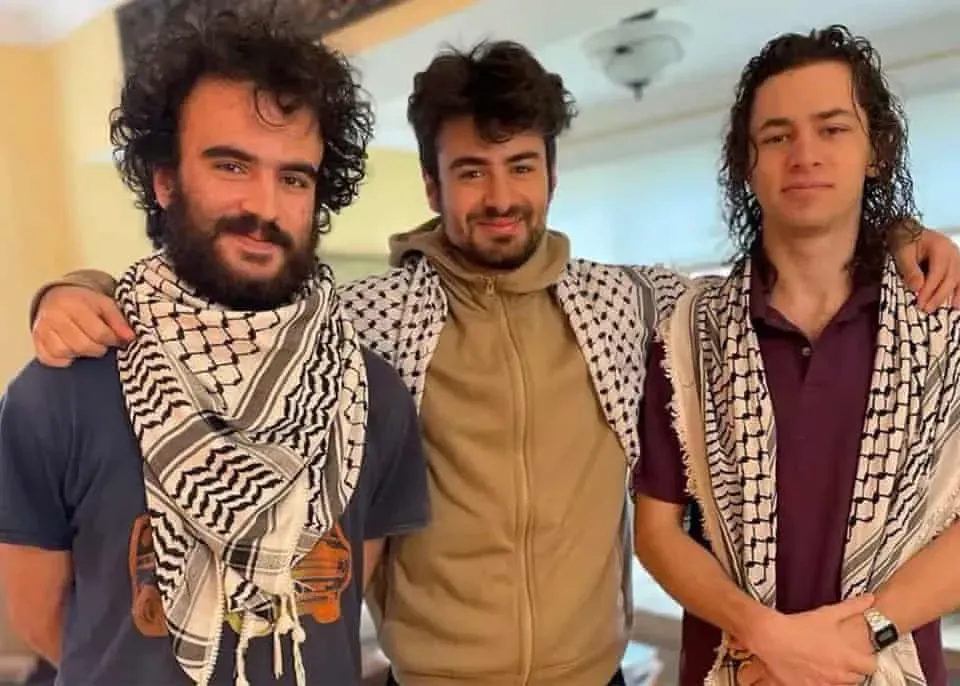
The man charged with shooting three young Palestinian college students in 2023 in the US state of Vermont was found guilty of three counts of attempted second-degree murder on Monday. The man said he was acting on orders from Mossad and the CIA.
The victims, Hisham Awartani, Kinnan Abdel Hamid and Tahseen Ahmed, were on their way to a family dinner when they were shot by 51-year-old Jason Eaton. They were speaking in Arabic, and two of them were wearing keffiyehs.
Eaton had pleaded not guilty but did not dispute that he was the shooter. His lawyers claimed that he should be found not guilty by reason of insanity, pointing to his claims that the United States and Israeli intelligence agencies transmitted orders to shoot the men to him via FM radio and that God was commanding him to protect his Jewish neighbours.
The attack left Awartani, who was a student at Brown University at the time, paralysed from the chest down.
“The verdict cannot undo what happened or erase the trauma our families still carry, but it affirms something fundamental: Jason Eaton is responsible for what he did,” Awartani’s mother, Elizabeth Price, told reporters after the decision.
The families, however, criticised the decision not to categorise the attack as a hate crime. In Vermont, recent hate crime charges have been filed only when a defendant explicitly uttered a slur during the crime.
In their statement, the families said Eaton had repeatedly used “hateful” words to describe their sons during the trial. “They were not the words of a man confused about who he shot, or why. They are the words of a man who saw three young men celebrating their friendship and wearing what made them feel closer to their far away families and home – and decided to kill them because of his own prejudices. We do not need a jury to tell us why our sons were targeted.”
“This was a hate crime. We have said so from the beginning. The law never made him answer for it. But we know what he did,” the families said in a statement after the verdict.
The three victims were wearing their keffiyehs in the courtroom, while the judge ordered other observers to remove their keffiyehs due to “concern about how that would impact the jury”, according to the New York Times.
The shooting, which occurred weeks after the onset of Israel’s genocide in Gaza, triggered calls for a hate crime investigation.