
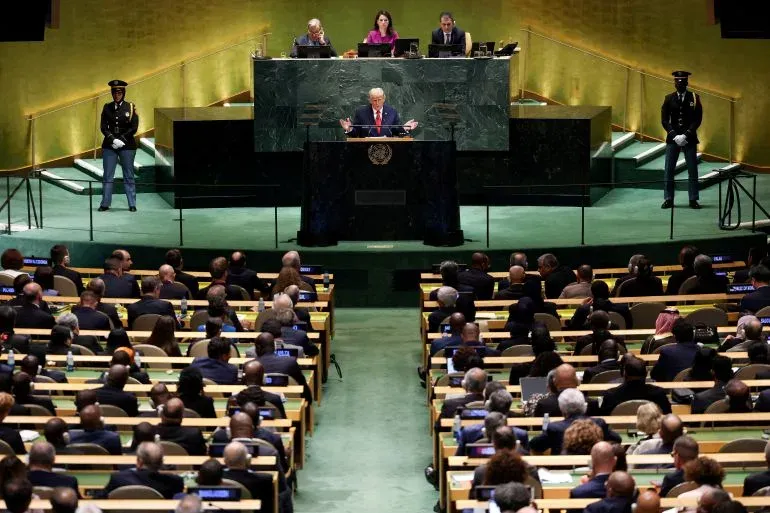
The war on the Gaza Strip and Israeli policies in the West Bank dominated the speeches of several world leaders during the first day of the United Nations General Assembly meetings in New York, amid warnings about the repercussions of the ongoing war and settlement expansion on the future of the two-state solution, alongside Western political and economic moves against the settlements.
In the latest display of pressure, the foreign ministers of Qatar, Egypt, Jordan, the UAE, Indonesia, Pakistan, Turkey and Saudi Arabia met in New York and expressed "deep concern" over the humanitarian situation in Gaza, calling on the occupation to implement its commitments under the first phase of the ceasefire plan, including the entry of aid and the rehabilitation of basic infrastructure.
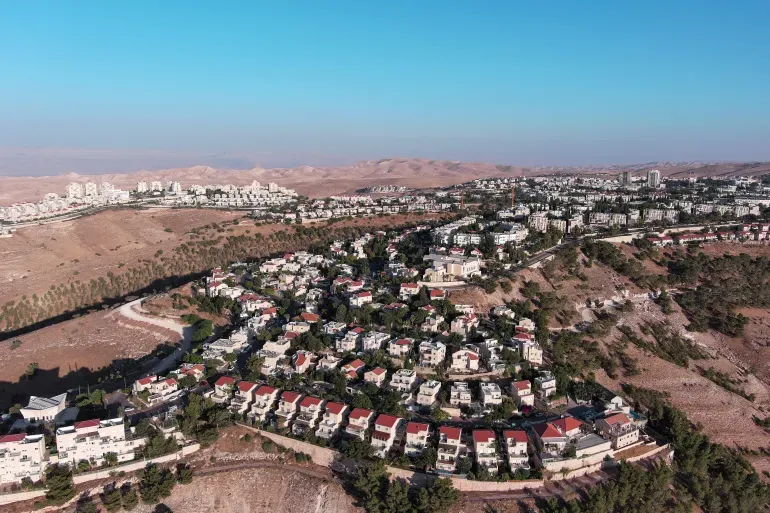
Earlier this month, 12 Western countries, including Britain, France, Canada, Spain and Nordic states, announced that they are pushing for or considering restrictions on trade with West Bank settlements. Britain, France and Canada announced they would introduce measures to ban trade in settlement products, while other European countries took unilateral steps in the same direction.
Yesterday, Britain issued a joint statement with Canada, France, Denmark, Finland, Iceland, Ireland, Norway, Portugal, Spain and Sweden, in which these countries affirmed that they had taken measures, supported imposing restrictions, or were considering additional steps against settlement activities.
UN Secretary-General António Guterres warned that violence, displacement and settlement expansion in the West Bank evoke the specter of ethnic cleansing, stressing that the two-state solution faces the risk of disappearing.
Turkish President Recep Tayyip Erdogan described Gaza as "the world's largest graveyard for children," saying it also records the highest proportion of child amputees globally.
Erdogan described the Strip as "the most inhumane and shameful concentration camp of our era," calling on countries that have not yet recognized the Palestinian state to recognize it and to intensify international pressure on "Israel."
He criticized the United States' decision to prevent Palestinian President Mahmoud Abbas from reaching New York, stressing that Turkey will continue to convey the voice of the Palestinian state from the UN platform. The Israeli delegation, which included "Israel's" ambassador to the UN Danny Danon, left the General Assembly hall during Erdogan's speech.
In the same context, Qatar's Emir Sheikh Tamim bin Hamad Al Thani said that "what happened in Gaza is genocide in every sense of the word," describing what the Strip witnessed as "a stain on the conscience of humanity."
He accused Israeli leaders of speaking publicly about encouraging the migration of Gaza's residents, calling on "Israel" to stop its military operations, withdraw from the Strip and lift the siege on it.
Jordan's King Abdullah II considered that the destruction in Gaza and the "de facto annexation" of lands in the West Bank are part of "an attempt to erase the Palestinian presence," and that Israeli policies aim to make the establishment of a Palestinian state impossible.
He described the forced removal of Palestinians from their homes in the West Bank as "forced displacement" and a "war crime," warning that Israeli "expansionism" makes "Israel" a regional threat.
French President Emmanuel Macron, in his final speech before the General Assembly before his term ends next year, said the situation in Gaza and Israeli policies in the West Bank raise growing concerns.
Macron objected to the way US President Donald Trump presented his plan to end the war, saying that despite peace declarations, not a single humanitarian corridor had been opened, and asking: "Are we simply standing by watching a scene that should make us all ashamed?"
He stressed that developments in the West Bank make the establishment of a Palestinian state less possible day by day, adding that those who believe that violating the sovereignty of neighboring states will enhance "Israel's" security are mistaken, because this policy "weakens its security, today and in the future."
In Britain, Prime Minister Andy Burnham said in his speech before the General Assembly that standing by "Israel" "does not justify the Israeli government's actions in Gaza or the West Bank."
He added that Britain "will not stand by" while suffering continues in Gaza and the two-state solution is threatened, criticizing in particular the push for settlement construction in the "E1" area, and warning that it could make a viable Palestinian state impossible.
Burnham defended his government's decision to restrict dealings with settlements, considering that Britain's continued talk of the two-state solution without backing its words with actions would lead to further erosion of public confidence in the policy.
In Brazil, President Luiz Inácio Lula da Silva said that "generations of Palestinians will carry the pain and shock" left by the "genocide committed by Netanyahu's government" against women and children in Gaza.
Lula criticized the measures taken against the International Criminal Court and its staff, warning that continued settlement expansion in the West Bank reduces the chances of implementing the two-state solution.
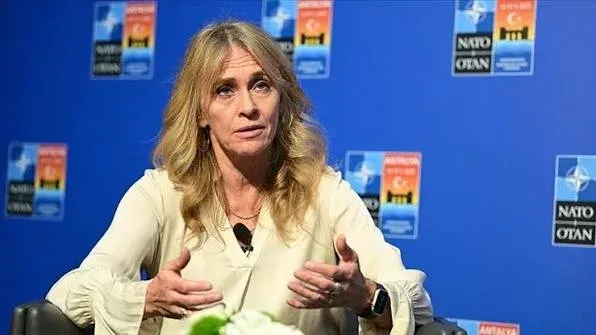
Outside the General Assembly hall, Syrian President Ahmed al-Sharaa criticized "Israel" during a discussion session organized by the Atlantic Council in New York on the sidelines of the meetings. Al-Sharaa stressed that "all policies cannot be determined based on an event that happened in history."
He added: "It is not right for what happened on October 7 to determine policy toward Syria. This is illogical and creates more security threats."
Al-Sharaa addressed a message to "Israel," saying: "If you want to protect your security, you must respect the security of others," considering that Israeli policies create new problems in "Israel's" surroundings instead of solving them.
He criticized Israeli attacks on Syria and Israeli military activity inside its territory, and said that the relations Syria is developing with the United States, Britain, Gulf states, Iraq and Lebanon are "successful," unlike the relationship with "Israel," adding: "Therefore I believe the problem is in Israel, not in Syria."