
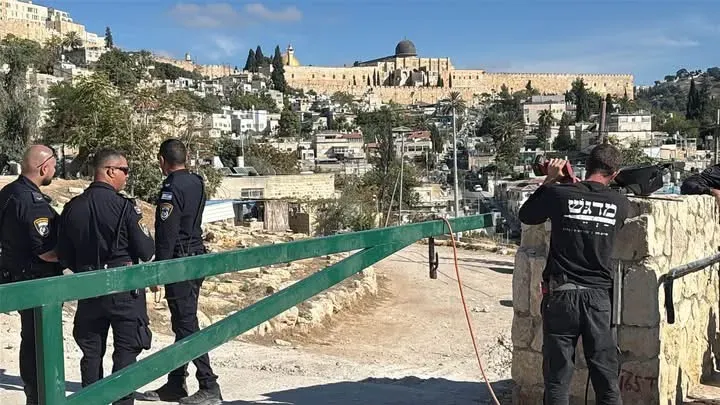
The Jerusalem Governorate said the settlement association Kadesha installed a locked iron gate on the only road leading to part of the Wadi al-Rababa neighborhood in the town of Silwan, south of the Al-Aqsa Mosque, isolating about 700 Jerusalemite residents out of the 1,700 people living in the neighborhood and imposing strict restrictions on their daily movement to and from their homes.
The governorate explained that the isolated area includes patients, the elderly and pregnant women who need continuous medical care and follow-up, noting that the road is a vital outlet for residents and is relied upon by ambulance, fire and emergency vehicles to reach the area.
It added that closing the road forces residents to use a difficult alternative stairway of about 300 steps that does not allow vehicles to pass, increasing their hardship and restricting their ability to reach basic services.
The governorate said these measures come within the gradual expansion of what is known as the "fictitious Sombuski cemetery" established on Wadi al-Rababa lands, explaining that in 2024 the occupation began transferring soil from the Ma'man Allah cemetery and planting fake gravestones at the site in an effort to entrench a colonial presence under the cover of the cemetery.
It added that the site's area, which was about 350 square meters, has gradually expanded to about 7–8 dunums, while responsibility for organizing it moved from the Jewish Cemeteries Department to the colonial Kadesha association, which seeks to consolidate its control over the land and expand its scope at the expense of residents' lands and their residential surroundings.
The governorate noted that during 2024 the colonial Kadesha association distributed violations and financial notices to a number of Wadi al-Rababa families worth hundreds of thousands of shekels, on the pretext of their vehicles being parked near the site, despite residents having used these lands for decades.
It pointed to the continuation of legal proceedings related to these violations amid attempts to pressure residents and push them to stop using the lands surrounding the site, limiting their access to and benefit from them.
The Jerusalem Governorate affirmed that the danger of what is happening goes beyond the closure of a road or restrictions on vehicle movement, affecting the daily life of about 700 Jerusalemite residents who have been denied free use of the road leading to their homes and whose daily movement has become more difficult with the closure of the vital outlet the area relies on to reach basic and medical services.
It warned that the continuation of these measures threatens the safety of residents, especially patients, the elderly and pregnant women, and obstructs the arrival of emergency vehicles and services to the area, in addition to the risks of expanding control over surrounding lands and isolating further parts of the neighborhood as part of a policy aimed at tightening the squeeze on Jerusalemite residents and limiting their access to their lands and homes.