
London (QNN) – The UK’s High Court ruled that the government’s ban of the pro-Palestinian group Palestine Action as a ‘terror group’ was unlawful.
The case was brought by co-founder Huda Ammori.
Responding to Friday’s ruling, Ammori called it a major victory for the group.
“This is a monumental victory for our fundamental freedoms in Britain and the Palestinian cause, overturning a decision remembered as one of the most extreme attacks on free speech in recent British history,” she said, calling the ban “a Trumpian abuse of power.”
Judges Victoria Sharp, Jonathan Swift, and Karen Steyn said Friday that “the nature and scale of Palestine Action’s activities” did not meet the “level, scale and persistence” required to justify proscription. They found the decision to ban Palestine Action “disproportionate.”
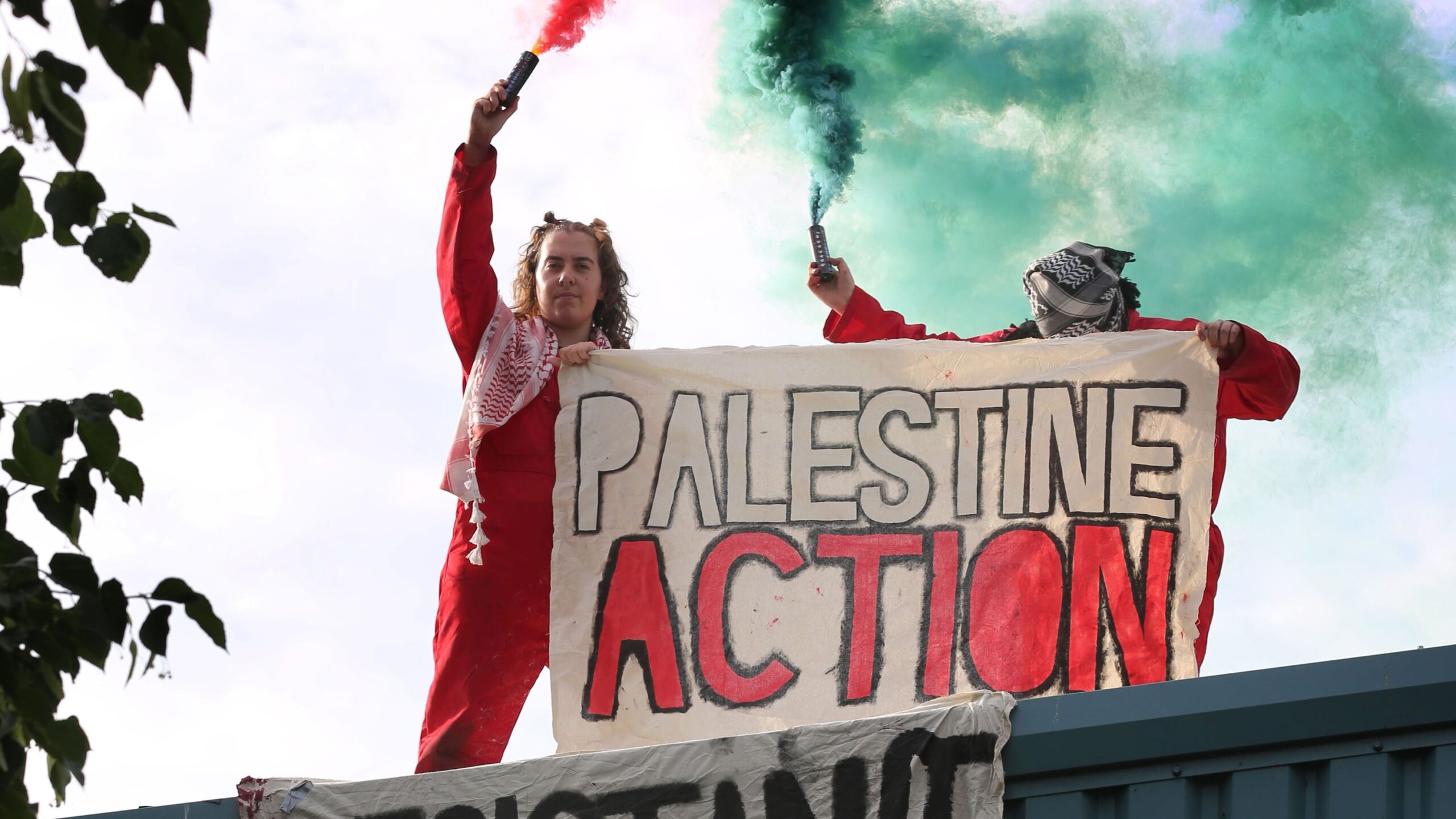
The government had banned Palestine Action after activists entered a Royal Air Force base in June to protest British military support for Israel’s genocide in Gaza, in which tens of thousands of Palestinians have been martyred.
The group was declared a terrorist organization, making support or membership a crime punishable by up to 14 years in prison. Since then, more than 2,700 people were arrested at protests for holding signs that said “I support Palestine Action,” with over 250 charged under the Terrorism Act.
Yasmine Ahmed, UK director of Human Rights Watch, called the ruling “a shot in the arm for British democracy,” saying the government had used anti-terror laws to suppress legitimate criticism of Israel.
Since its founding in 2020, Palestine Action has carried out direct action protests at UK military and industrial facilities, including breaking into sites run by Elbit Systems UK, the British arm of an Israeli weapons company.
Officials said the group caused millions of pounds in damage, affecting national security.
The judges stated that, although “a very small number of its actions amounted to terrorist action,” criminal law was already available to prosecute those involved without needing proscription.
They ruled not to quash the ban immediately, pending another hearing on whether it should remain “while an appeal remains possible,” giving both legal teams until Feb. 20 to prepare.
London’s Metropolitan Police said that in light of the ruling, people supporting Palestine Action would not be arrested, though evidence would still be gathered for possible enforcement later.
Ammori said any government move to challenge the decision would be “profoundly unjust,” while the futures of thousands of supporters – “many of them elderly or disabled, facing up to 14 years in prison” – were uncertain.
“Any such attempt would prolong that injustice,” she said.
Outside the court, with supporters chanting pro-Palestinian slogans, artist Nicola Moxham, previously arrested for her support of the group, described the ruling as “vindication.”
She called the decision “an absolute triumph for direct action in support of Palestine Action and in opposition to the genocide of Palestinians and destruction in Gaza.”
CAGE International stated the ruling was “a decisive rejection of efforts to shield corporations complicit in arming the genocide in Gaza.”
Anas Mustapha, head of public advocacy for the group, said: “While the structure of terrorism laws remains, our fundamental freedoms are still based on political whims.” He added, “Today’s ruling is the legally correct outcome, but one earned through principled sacrifice and collective will.”
He said the judgment should lead to withdrawal of charges against “all imprisoned Palestine Action activists and the thousands who followed their conscience in the largest civil disobedience campaign the country has witnessed in recent years.”
Ammori said the group was banned because its actions against the UK branch of Israel’s top arms maker, Elbit Systems, cost the company millions in profit.
“Banning Palestine Action was always about appeasing pro-Israel lobby groups and arms makers, and never about terrorism,” she said.